



Why Holi Is More Than a Festival of Colours: History, Meaning, and Significance

Holi, often called the "Festival of Colors," goes far beyond its vibrant exterior to embody profound spiritual, cultural, and social significance in Hindu tradition. While millions worldwide recognize the joyous spectacle of coloured powders and water fights, the deeper essence of this ancient celebration encompasses themes of renewal, forgiveness, unity, and the eternal triumph of good over evil. This spring festival, celebrated primarily in India and Nepal, carries centuries of mythology, religious symbolism, and cultural practices that extend far beyond its colourful facade. Understanding Holi's rich history reveals why this festival remains one of the most spiritually meaningful and socially transformative celebrations in the Hindu calendar, offering lessons in community bonding, spiritual purification, and the celebration of life's cyclical nature.
Holi represents one of Hinduism's most significant festivals, celebrated annually during the spring season to mark the victory of good over evil and the arrival of warmer weather. The festival spans two days, beginning with Holika Dahan (the burning of bonfires) and culminating in Rangwali Holi, where participants joyously throw coloured powders and water at each other.
The designation "Festival of Colors" stems from the tradition of using vibrant gulal (coloured powder) and coloured water during celebrations. These colours originally held deep symbolic meaning, with each hue representing different aspects of life, nature, and spirituality. Red symbolises love and fertility, yellow represents turmeric's healing properties, blue honours Lord Krishna, and green celebrates new beginnings and harvest.
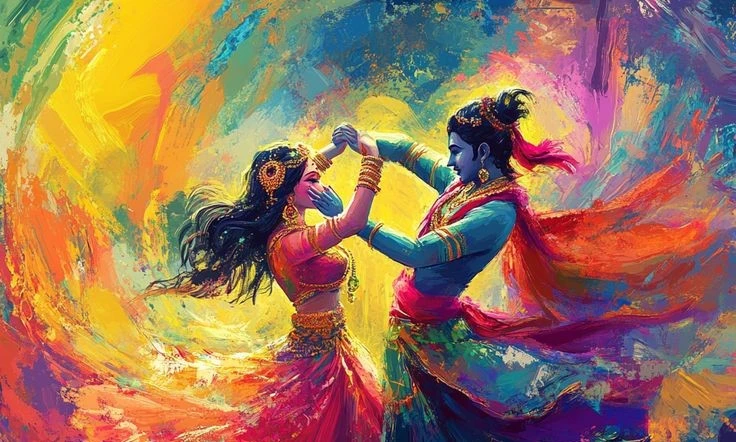
The practice of throwing colours dates back over 1,500 years, originating from various Hindu mythological stories. Ancient texts describe how Lord Krishna, known for his blue skin, playfully applied colours to his beloved Radha and other gopis (cowherd girls) in Vrindavan. This divine play, called "Lila," established the foundation for modern Holi celebrations.
Holi's origins trace back to ancient Hindu scriptures and Puranas, with multiple mythological stories contributing to its significance of Holi. The most prominent legend involves Prahlada, a young devotee of Lord Vishnu, and his evil aunt Holika. King Hiranyakashipu, Prahlada's father, despised his son's devotion to Vishnu and conspired with his sister Holika to eliminate the boy.
Holika possessed a magical cloak that protected her from fire, and she planned to burn Prahlada alive by sitting with him in a blazing pyre. However, due to Prahlada's unwavering faith and divine intervention, the cloak flew from Holika to protect the innocent child, while she perished in the flames. This story establishes Holi's fundamental theme of good triumphing over evil.
Another beloved mythology connects Holi to Lord Krishna's childhood in Vrindavan. Young Krishna, self-conscious about his dark blue skin, complained to his mother Yashoda about Radha's fair complexion. Yashoda playfully suggested he colour Radha's face any shade he desired, leading to the tradition of applying colours during Holi traditions.
Holi symbolism encompasses the spiritual journey from darkness to light, representing inner purification and the renewal of relationships. The festival embodies several profound spiritual concepts that extend far beyond its external celebrations. The burning of Holika represents the destruction of ego, negative emotions, and past grievances, allowing individuals to start fresh with clean hearts and minds.
The application of colours symbolises the diversity of human nature and the unity that exists beneath surface differences. When people of all castes, classes, and backgrounds come together covered in the same colours, social barriers temporarily dissolve, reflecting the Hindu principle that all souls are fundamentally equal.
Holi serves as an opportunity for spiritual cleansing, where individuals seek forgiveness from those they may have wronged and release accumulated negative karma. The festival encourages people to let go of grudges, heal broken relationships, and approach life with renewed positivity and compassion.
Celebrating Holi varies significantly across different regions of India, each adding unique cultural elements while maintaining core spiritual significance. In Mathura and Vrindavan, Krishna's birthplace, celebrations extend for over a week with elaborate temple ceremonies, classical music performances, and traditional dance presentations.
West Bengal celebrates Holi as "Dol Jatra," featuring processions with decorated idols of Radha and Krishna, accompanied by traditional Bengali music and dance. The celebration emphasises devotional singing and community feasting, reflecting Bengali cultural values of artistic expression and social harmony.
Northern states like Punjab, Haryana, and Uttar Pradesh celebrate Holi with particular enthusiasm, incorporating regional folk songs, traditional sweets, and community bonfires. These celebrations often include the consumption of bhang (cannabis-infused drinks), which has religious significance in certain Hindu traditions.
Holi serves as a powerful social equaliser, temporarily dismantling hierarchical structures that typically govern Indian society. During the festival, social norms relax significantly, allowing people from different castes, economic backgrounds, and social positions to interact freely and joyously.
The tradition of seeking forgiveness and offering sweets to neighbours, regardless of their social status, reinforces community bonds and promotes social harmony. This aspect of Holi demonstrates the festival's role in maintaining social cohesion and preventing long-term conflicts within communities.
Holi provides one of the few occasions in traditional Indian society where gender interactions become more relaxed and playful. Women and men participate equally in colour throwing, dancing, and festivities, temporarily suspending strict gender protocols that might otherwise govern social interactions.
Each colour used during Holi festival celebrations carries specific spiritual and cultural meanings rooted in Hindu philosophy and natural symbolism. Understanding these colour meanings enhances appreciation for the festival's deeper meaning of Holi beyond mere entertainment and social interaction.
Red represents love, passion, and fertility, connecting to the divine love between Radha and Krishna. Yellow, derived from turmeric, represents knowledge, learning, and the sacred. Green symbolises new beginnings, harvest, and nature's renewal, while blue honours Lord Krishna and represents the infinite sky and ocean.
Traditional Holi celebrations emphasised natural, herbal colours that provided therapeutic benefits alongside spiritual significance. Modern synthetic colours, while more vibrant and long-lasting, lack these healing properties and may cause skin irritation or environmental damage. Many conscious celebrants now choose eco-friendly alternatives that align with the festival's original spiritual principles.
Holi is primarily celebrated to commemorate the victory of good over evil, as depicted in the legend of Prahlada and Holika. The festival also marks the arrival of spring, celebrates divine love between Radha and Krishna, and promotes social unity and forgiveness within communities.
Holi traditionally lasts for two days. The first day, called Holika Dahan or Chhoti Holi, involves lighting bonfires and performing prayers. The second day, Rangwali Holi or Dhulandi, features the famous colour-throwing celebrations.
Red symbolises love and fertility, yellow represents knowledge and turmeric's healing properties, blue honours Lord Krishna, green signifies new beginnings and nature's renewal, and orange represents courage and spiritual transformation. Each colour carries deep spiritual significance in Hindu festivals.
While Holi originates from Hindu tradition, the festival has gained global popularity and is now celebrated by people of various cultural and religious backgrounds. Many non-Hindu participants appreciate Holi's messages of unity, joy, and the triumph of good over evil.
Holi transcends its popular image as merely a colourful festival to embody profound spiritual, cultural, and social significance that has sustained Hindu communities for millennia. The celebration's emphasis on forgiveness, unity, and the victory of good over evil provides timeless wisdom relevant to contemporary global challenges. Understanding Holi's rich mythology, regional variations, and symbolic meanings reveals why this festival continues to attract participants worldwide, regardless of their cultural background. As modern celebrations evolve, maintaining awareness of environmental sustainability and traditional practices ensures that future generations can experience Holi's authentic spiritual benefits while preserving its cultural integrity.

